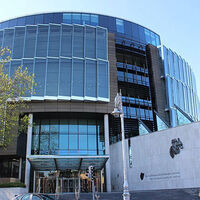



SEATTLE (CN) - A Ninth Circuit panel on Tuesday revived nuisance claims brought by two businesses that said Seattle was responsible for deteriorating conditions inside the police-free, autonomous protest zone created during a summer of civil unrest six years ago.
"Even if a claim is untimely filed, the statute of limitations may be tolled if permitted by state law," U.S. Circuit Judge Margaret McKeown, a Bill Clinton appointee, wrote in a 21-page opinion.
In June 2020, amid widespread protests in the wake of the murder of George Floyd at the hands of Minnesota police, Seattle protesters barricaded a 16-block portion of the Capitol Hill neighborhood. The Seattle Police Department withdrew from its nearby precinct. The area became known as CHOP, which stands for the Capitol Hill Occupying Protest.
Police forcibly disbanded CHOP on July 1, but protesters and encampments remained in the area through the end of the year.
Within the occupied area was a fast-casual Korean food restaurant called Oma Bap on the bottom floor of an apartment building owned by Hugo Properties. Both businesses sued the city, asserting claims of negligence, violation of substantive due process and nuisance.
The businesses accused Seattle of fostering a dangerous environment and disregarding public safety, negatively affecting their businesses.
The lower court dismissed the claims, finding the businesses didn't prove the city had breached any duties owed to them. It also found the statute of limitations had elapsed on the nuisance claim.
On appeal, the Ninth Circuit panel issued a mixed ruling.
The businesses intended to recover for economic harm by invoking the state-created danger doctrine, but the panel rejected the argument.
The state-created danger doctrine only allows recovery for state-created harm to bodily integrity and autonomy rather than lost profits.
"Like our circuit, other circuits' state-created danger cases involve dangers to life or liberty," McKeown wrote. "None encompass economic or property damage."
The businesses also didn't cite any cases that hold the state-created danger doctrine provides an affirmative right to cover property damage and losses of revenues and profits. McKeown noted the Ninth Circuit has always been reluctant to expand the concept of substantive due process.
"And we must 'exercise the utmost care whenever we are asked to break new ground in this field,'" McKeown wrote. "That care counsels against expanding the state-created danger doctrine to cover this untrodden ground."
Turning to the nuisance claims, the appeals court panel found that while the lower court properly determined the businesses didn't file their nuisance claims in time, it should have allowed them to argue for an exception.
The businesses brought the claims under a Washington statute that provides "an obstruction to the free use of property, so as to essentially interfere with the comfortable enjoyment of the life and property, is a nuisance."
While there is a two-year statute of limitations on nuisance claims, that limit is subject to equitable tolling available under state law. Both businesses filed their claims in 2023, nearly three years after the city police abandoned its precinct in the CHOP zone, and about two-and-a-half years after protest activity cleared out of the area.
However, the businesses may be eligible for an extension under a rule applying to putative class members denied class certification. Since the businesses were absent members of the putative class in a lawsuit containing nearly identical nuisance claims, the statute of limitations on those claims would only have begun to run in 2022 when class certification was denied.
"Because we do not have a definitive ruling from the Washington Supreme Court, as with the statute of limitations question, we do our best to predict what the court would do," McKeown wrote.
The appeals court panel predicted the state Supreme Court would incorporate the rule extending the statute of limitations and sent the claims back to the lower court for further proceedings.
U.S. Circuit Judge Richard Paez, a fellow Clinton appointee, and U.S. Circuit Judge Roopali Desai, a Joe Biden appointee, rounded out the panel.
The businesses did not immediately respond to a request for comment, and the Seattle City Attorney's Office declined to comment.
Source: Courthouse News Service